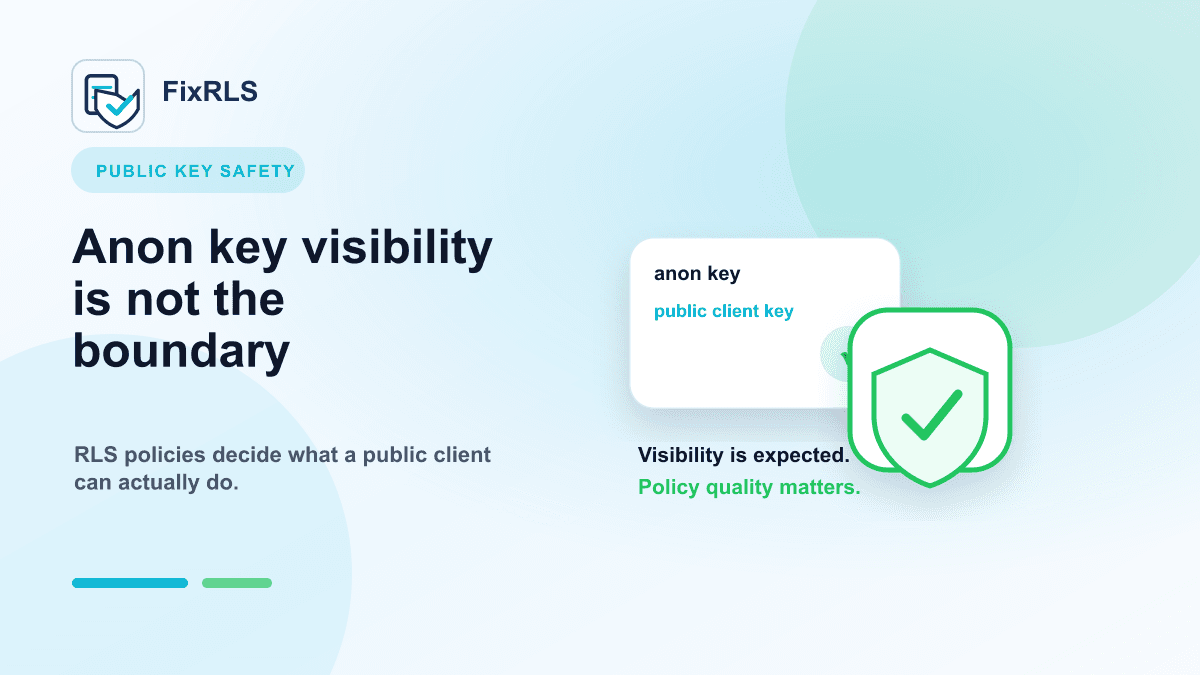
Is It Safe to Expose Your Supabase Anon Key?
How to reason about visible Supabase anon keys, RLS policies, and what actually protects user data.
A lot of developers panic the first time they see their Supabase anon key in frontend code.
That reaction is understandable.
The name "anon key" sounds like a secret.
But in many Supabase frontend setups, the anon key has historically been used as a public browser key.
The real question is not simply:
Is the anon key visible?
The better question is:
What can someone do with it?
Frontend keys are visible by design
Any key used in browser-side JavaScript can be seen by users.
That includes keys in:
- React apps
- Next.js client components
- Vite apps
- mobile bundles
- public environment variables
- network requests
So if a Supabase key is used in the frontend, you should assume it is public.
That does not automatically mean your database is open.
It means your RLS policies matter.
The anon key is not the main security boundary
The key identifies how the client talks to Supabase.
It does not magically protect every table.
For user data, your real protection should come from:
- Row Level Security
- table policies
- storage policies
- auth checks
- server-only secret handling
If RLS is disabled or too broad, a public key can become dangerous.
If RLS is correctly configured, the public key can be used safely for normal client-side operations.
The dangerous case
This is risky:
alter table profiles disable row level security;This is also risky:
create policy "Anyone can do anything"
on profiles
for all
using (true)
with check (true);
In those cases, the problem is not just that a frontend key exists.
The problem is that your policies allow too much.
A safer pattern
For a user-owned table:
create table profiles (
  id uuid primary key default gen_random_uuid(),
  user_id uuid not null,
  display_name text,
  created_at timestamptz default now()
);
You might use policies like:
create policy "Users can view their own profile"
on profiles
for select
to authenticated
using (
  auth.uid() = user_id
);

create policy "Users can update their own profile"
on profiles
for update
to authenticated
using (
  auth.uid() = user_id
)
with check (
  auth.uid() = user_id
);
This means a signed-in user can only access rows that belong to them.
That is what makes a public frontend key acceptable.
What about unauthenticated users?
Supabase also supports anonymous access patterns.
For example, you might intentionally allow public reads for published content:
create policy "Anyone can read published posts"
on posts
for select
to anon, authenticated
using (
  published = true
);
That can be valid.
But it should be intentional.
Public access should come from a policy you understand, not from accidentally disabled RLS.
Common mistakes
Here are the mistakes I see most often:
- Treating the anon key as the only security layer.
- Disabling RLS to fix an error.
- Using
service_rolein the frontend. - Writing
using (true)without understanding the consequence. - Forgetting storage bucket policies.
- Testing only the happy path.
The last one is especially common.
If User A can access User B's data, the app is not secure just because User A's own dashboard works.
How to think about it
Ask three questions:
- Is this key expected to be public?
- Are the tables protected by RLS?
- Have I tested the denied case?
The denied case matters.
You need to prove that the wrong user cannot access the row.
A tool I built for this
I built FixRLS to help developers reason about Supabase keys and RLS policies without pasting secrets.
For anon key exposure questions, the guide is here:
https://fixrls.dev/supabase-anon-key-exposed
It helps generate key placement guidance, RLS starting points, and proof-of-fix tests.
Final thought
Seeing a Supabase frontend key in your browser bundle is not automatically a disaster.
But it is a reminder:
Your public key is not your security boundary. Your policies are.
If your RLS policies are missing, too broad, or untested, the key is not the thing that saves you.
Related FixRLS page
For this specific issue, use the matching FixRLS page: https://fixrls.dev/supabase-anon-key-exposed
Author

Categories
More Posts
How I Fixed "new row violates row-level security policy" in Supabase
A practical mental model for fixing Supabase new row violates row-level security policy errors without bypassing RLS.
Why You Should Never Put Your Supabase `service_role` Key in the Frontend
Why the Supabase service_role key must stay out of browser code and what to do if it leaked.
Supabase RLS INSERT Policies: Why `WITH CHECK` Matters
Why Supabase INSERT policies need WITH CHECK and how that differs from USING for existing rows.
Newsletter
Join the community
Subscribe to our newsletter for the latest news and updates